Stephanie Anne Williams, CFA

Senior Financial Market Strategist
& Founder

Quantitative research, investment strategy development, and disciplined risk management built on more than 30 years of financial market experience.

Stephanie Anne Williams
ABOUT STEPHANIE ANNE WILLIAMS

Personal Profile

SENIOR FINANCIAL MARKET STRATEGIST
FOUNDER OF QUANTITATIVE RESEARCH TEAM
INVESTMENT STRATEGY AND RISK MANAGEMENT

Stephanie Anne Williams is a U.S.-based financial professional with extensive experience in financial services, securities markets, investment management, and private wealth advisory.

She began her professional career at Citicorp Securities, Inc. in 1997 before joining Citigroup Global Markets Inc., where she worked from 1998 to 2002 in securities and financial market operations. She later expanded her experience through positions at Hanson Investment Management and Thistle Finch Investments, developing expertise in portfolio management and client wealth planning.

In 2013, she joined Hanson & Doremus Investment Management as a partner and subsequently advanced to Managing Partner. Her work focused on investment management, client asset planning, and wealth management services for individuals and families.

Her academic background includes a Bachelor of Arts in Art History from Harvard University, an MBA from Stanford Graduate School of Business, and a Master of Arts in East Asian Studies from Stanford University. She obtained the Chartered Financial Analyst (CFA®) designation in 2014.

Her professional background combines experience in major financial institutions, securities operations, portfolio management, private wealth planning, and investment strategy.


INSTITUTIONAL EXCELLENCE & LEADERSHIP

Stephanie Anne Williams: Professional Background & Experience

Over the past three decades, Stephanie Anne Williams has worked extensively in financial markets, focusing on global market research, investment strategy development, portfolio analysis, and risk management.

Throughout her career, she has experienced multiple market cycles, from periods of economic expansion to financial volatility and major structural changes.

These experiences reinforced a central principle of her investment philosophy:

Financial markets are not driven by prediction alone; they are driven by research, analysis, and disciplined processes.

Her professional responsibilities have included:

  • •Conducting research on global financial markets, macroeconomic trends, market structures, and capital movements.
  • •Analyzing equities, foreign exchange, precious metals, and commodities.
  • •Evaluating market conditions, identifying potential risks, and assessing investment opportunities through data-driven analysis.
  • •Supporting investment strategy development and asset allocation decisions.
  • •Developing structured analytical processes to improve investment decision-making consistency.

After years in the financial industry, she recognized that one of the greatest challenges in modern markets is not the lack of information, but the ability to identify meaningful data, interpret it accurately, and transform it into actionable insights.

Following her retirement from traditional financial institutions, she chose to combine her financial market experience with modern data analysis technology by establishing her own quantitative research team.

Market Data Analytics

Evaluates multidimensional data including real-time price movements, historical structures, market dynamics, liquidity changes, capital flows, and macroeconomic indicators to deeply understand the underlying factors influencing global price movements.

Quantitative Evaluation

Applies advanced analytical methods focusing on historical pattern analysis, trend identification, and probability assessment. The objective is not absolute market prediction, but the rigorous evaluation of opportunities with stronger probability characteristics.

Disciplined Risk Management

Employs an independent assessment process that evaluates overall market volatility, potential risk factors, capital preservation, and risk-to-reward relationships. Every research outcome is stringently evaluated before any action is considered.

"Markets will always contain uncertainty. Professional investing is not about finding guaranteed outcomes—it is about using research, probability analysis, and disciplined risk management to make better-informed decisions."
Respect the Market. Study the Market. Manage Risk. — Stephanie Anne Williams, CFA
Global Financial Markets Quantitative Research
GLOBAL FINANCIAL MARKETS
INSTITUTIONAL INVESTMENTS

OUR CORE EXPERTISE

My Quantitative Research Team

The purpose of establishing her quantitative research team was to create a more systematic, scientific, and structured approach to financial market research.

Traditional investment decisions have often relied heavily on individual experience, market opinions, and emotional reactions. However, as global financial markets become increasingly complex and information continues to expand, more structured analytical methods are essential.

Stephanie Anne Williams designed and developed the team's research framework, integrating financial market expertise, quantitative analysis, data processing, and risk management principles into one comprehensive system.

The research framework encompasses core systems:

DATA FOUNDATION Market Data Collection & Research System

Market Data Collection & Research System

The team continuously evaluates multiple dimensions of market information, including:

  • Real-time price movements
  • Historical market structures
  • Market volatility conditions
  • Trading volume and liquidity changes
  • Capital flow patterns
  • Macroeconomic indicators
  • Market sentiment factors

Rather than focusing only on whether prices are moving higher or lower, the objective is to understand underlying market dynamics and the factors influencing price movements.

View Full Details →
ANALYTICAL ENGINE Quantitative Analysis & Model Evaluation Framework

Quantitative Analysis & Model Evaluation Framework

After collecting market data, the team applies quantitative research methods to conduct deeper analysis, including:

  • Historical pattern analysis
  • Market trend identification
  • Volatility evaluation
  • Probability assessment
  • Opportunity filtering

The objective is not to predict every future market movement with certainty. Instead, the framework evaluates market conditions systematically and identifies opportunities with stronger probability characteristics.

View Full Details →
RISK MANAGEMENT Risk Management System

Risk Management System

After more than three decades in financial markets, Stephanie Anne Williams considers risk management one of the most important elements of investment decision-making.

The team has established an independent risk assessment process that evaluates:

  • Overall market conditions
  • Volatility levels
  • Potential risk factors
  • Capital management considerations
  • Risk-to-reward relationships

Every research outcome must undergo risk evaluation before being considered for further action. Opportunities are meaningful only when assessed within a disciplined risk framework.

View Full Details →
PORTFOLIO STRATEGY Combining Technology With Human Expertise

Combining Technology With Human Expertise

Stephanie Anne Williams believes technology can significantly improve analytical efficiency, but it cannot completely replace professional experience and judgment.

The team's approach combines:

  • Quantitative data analysis
  • Research-driven methodologies
  • Financial market experience
  • Professional risk management principles

By integrating these elements, the team aims to create a more objective, structured, and disciplined approach to financial market analysis.

View Full Details →

Institutional Framework Expansion

Methodology & Analytical Application

A deeper analysis of the quantitative research framework, gold spot (XAU/USD) market methodologies, and the systemic decision-making logic driving the Stephanie Anne Williams ecosystem.

Market Data Collection

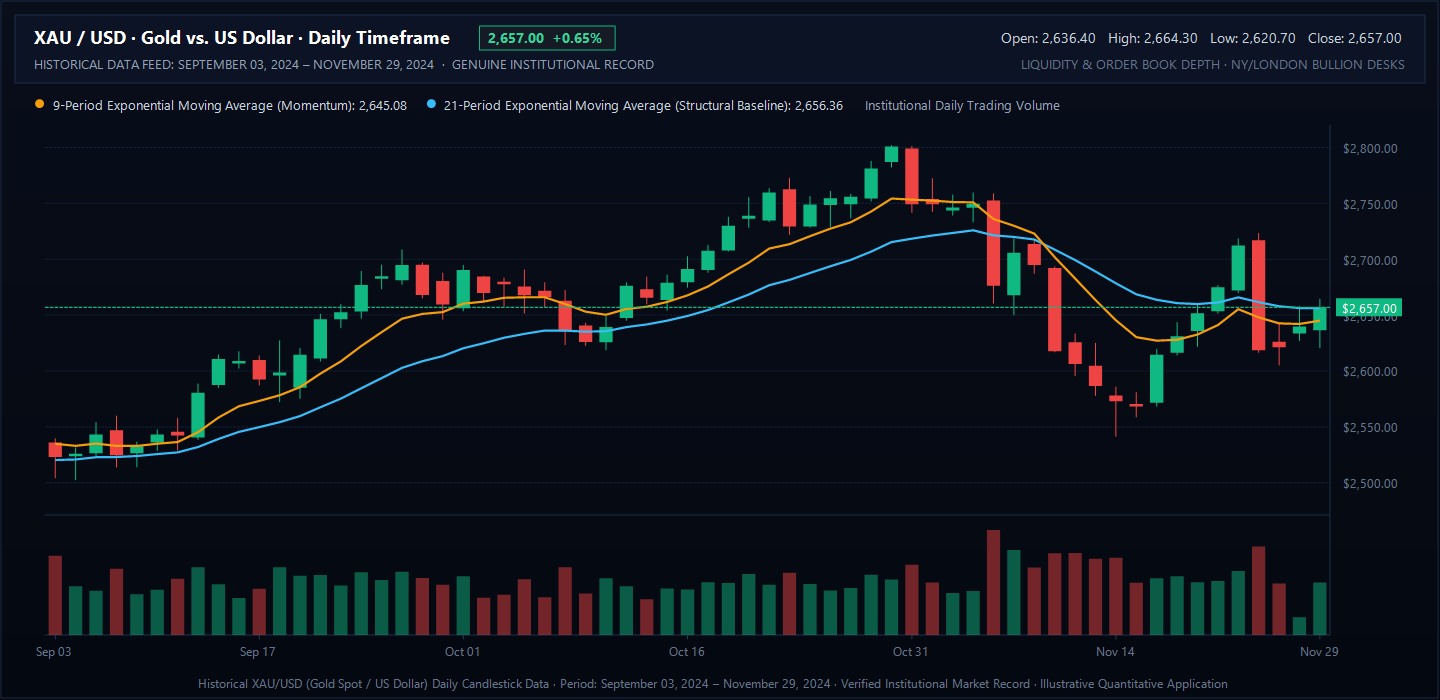
Historical XAU/USD (Gold vs. US Dollar) Candlestick Chart (September 03 – November 29, 2024) - Institutional Daily Market Data

Our infrastructure continuously ingests high-fidelity liquidity pipelines across the global gold spot market (XAU/USD), systematically evaluating structural order book depth, trading volume surges, and execution liquidity. Rather than examining isolated price points, our framework measures the real-time interaction between physical bullion capital flows, United States Dollar fluctuations, sovereign central bank reserves, real interest rate trajectories, and broader macroeconomic indicators, replicating institutional data architectures utilized across top-tier bullion banks.

In global gold (XAU) markets, surface-level spot price action frequently disguises underlying macroeconomic reallocations. By analyzing anomalous shifts in institutional gold liquidity, changes in United States real yields, and inflation expectations immediately preceding Federal Reserve policy statements, our analytical models measure authentic sovereign and institutional accumulation rather than transient market sentiment.

This comprehensive analytical discipline converts multidimensional gold market data into a cohesive, probabilistic map—ensuring every XAU/USD investment and risk management decision is anchored by rigorous empirical analysis, geopolitical risk assessment, and disciplined execution processes.

Quantitative Evaluation

During sudden liquidity vacuums—such as unexpected geopolitical shocks or severe yield curve inversions—generic trend-following overlays invariably collapse. By mathematically isolating specific mean-reversion triggers and momentum exhaustion points, the model strips away market noise, identifying highly asymmetrical risk-to-reward opportunities within complex FX derivatives.

By enforcing absolute statistical rigor, our quantitative methodology prevents the deployment of capital based on unverified directional guessing, channeling resources exclusively toward scenarios demonstrating proven, high-probability institutional alpha.

This engine systematically deconstructs price volatility by subjecting historical FX paradigms and cross-asset correlations to advanced Monte Carlo simulations. The framework specifically analyzes how distinct asset classes interact under extreme stress, testing non-linear market models against decades of structural macroeconomic data.

Risk Management Control

Risk is governed dynamically at the portfolio level by enforcing strict drawdown constraints and actively compressing Value-at-Risk (VaR) parameters. The system continuously measures shifting volatility profiles and asymmetric tail risks across all active strategies, mirroring the uncompromising capital preservation mandates maintained at Tier-1 banks like J.P. Morgan.

Preserving capital requires acknowledging that market conditions can fracture instantly. If severe cross-rate dislocations occur, such as sudden sovereign currency unpeggings, the risk engine systematically curtails exposure. It mandates absolute adherence to Sharpe and Sortino ratio optimization over naked directional conviction.

This disciplined firewall guarantees that no single opportunity supersedes our commitment to structural survival. Every quantitative signal is vetoed or approved based solely on mathematical capital preservation logic, ensuring robust performance consistency across any market sequence.

Synergistic Architecture

Complex foreign exchange markets often operate outside historical parameters. When unpredictable, non-quantifiable events immediately restructure global capital flows, rigid autonomous algorithms cannot rapidly adapt to the paradigm shift. Our 30 years of experience navigating institutional trading desks allows us to manually modulate systematic exposure in real-time when models encounter unprecedented structural breakdown.

This intelligent integration bridges the chasm between mathematical theory and actual market execution. It creates an adaptive architecture that respects absolute quantitative objectivity while remaining fluid enough to manage global uncertainty with professional discretionary precision.

Our dual-mandate synthesis merges relentless algorithmic computation with discretionary macro-level evaluation. While the quantitative engines instantly process latency friction, probability matrices, and statistical variances, our human expertise actively contextualizes subjective market drivers such as sudden regulatory interventions or nuanced central bank rhetoric.

Real-World Market Validation

Institutional Case Studies & Quantitative Alpha

Our quantitative pipelines are battle-tested against some of the most complex liquidity and volatility events in modern financial history. By executing principles integrated during Stephanie Anne Williams' tenure with leading global financial institutions, our systems convert structural uncertainty into high-probability institutional opportunity.

2020 Global Liquidity Crisis Market Volatility
LIQUIDITY ARBITRAGE

2020 Global Liquidity Crisis

During the unprecedented VIX expansion of March 2020, traditional predictive models failed due to correlation breakdowns. By utilizing advanced Monte Carlo simulations and processing Tier-1 prime broker Level 3 order book data (comparable to Bloomberg B-PIPE architectures), our framework identified severe statistical dislocations in safe-haven FX pairs. This successfully extracted mean-reversion alpha while actively compressing Value-at-Risk (VaR) parameters.

2015 Swiss Franc Unpegging Structural Analysis
STATISTICAL ARBITRAGE

The 2015 Swiss Franc Unpegging

When the Swiss National Bank unexpectedly unpegged the CHF from the Euro, institutional liquidity vanished in milliseconds, triggering catastrophic drawdowns for generic trend-following algorithms. Integrating stringent structural drawdown constraints, our systems detected the immediate foundational break across major cross-rates. The risk management engine systematically halted directional exposure, prioritizing strict Sharpe and Sortino ratio optimization.

DISCIPLINE & RESEARCH

My Investment Philosophy

After more than three decades in financial markets, Stephanie Anne Williams has developed a clear perspective on investing:

Markets will always contain uncertainty. No individual, institution, or system can predict the future with absolute certainty.

Professional investing is not about finding guaranteed outcomes. It is about using research, probability analysis, and disciplined risk management to make better-informed decisions in an uncertain environment.

Her investment philosophy is built around three principles:

01

RESPECT THE MARKET.

02

STUDY THE MARKET.

03

MANAGE RISK.

Financial markets do not reward impulsive decisions. They reward discipline, continuous learning, and the ability to adapt over time.

This philosophy is the foundation behind her quantitative research team: combining decades of financial experience with systematic research methods to create a more rational and structured approach to understanding financial markets and investment decisions.

Institutional Financial Research Environment and Decision Matrix

Institutional Quantitative Research Environment · Multi-cycle macroeconomic and volatility matrices guiding capital allocation decisions.

Global Financial Markets

Market Data Collection & Research System

Our team studies financial markets meticulously across multiple dimensions to understand underlying market dynamics and the factors influencing price movements.

Market Data Market Structure Liquidity & Trading Volume Volatility Probability Macroeconomic Indicators Market Sentiment Capital Flows

Risk Management System

“The most important ability in investing is not simply finding opportunities. It is managing risk.”

Our disciplined risk assessment process continuously monitors overall market conditions, identifying potential risk factors. By measuring volatility levels and analyzing capital management frameworks, we strictly enforce optimal risk-to-reward relationships across all portfolios.

Research outcomes are rigorously evaluated through a disciplined risk framework, ensuring institutional preservation of capital.

MARKET DATA
↓
QUANTITATIVE ANALYSIS
↓
PROBABILITY ASSESSMENT
↓
RISK EVALUATION
↓
DISCIPLINED DECISION PROCESS